One of the best financial perks of being self-employed is access to retirement plans with much higher contribution limits than a regular IRA. The two most popular are the Solo 401(k) and the SEP IRA. Both let you save tens of thousands of dollars a year and cut your tax bill — but they work differently.
Key takeaways
- For 2027, the total limit for both plans rises to $75,000 (up from $72,000 in 2026).
- A Solo 401(k) usually lets you save more at low and moderate incomes because you contribute as both “employee” and “employer.”
- A SEP IRA is simpler and better if you have, or plan to hire, employees.
What is a Solo 401(k)?
A Solo 401(k) (also called an individual 401(k)) is a 401(k) for a business owner with no employees other than a spouse. You contribute in two roles:
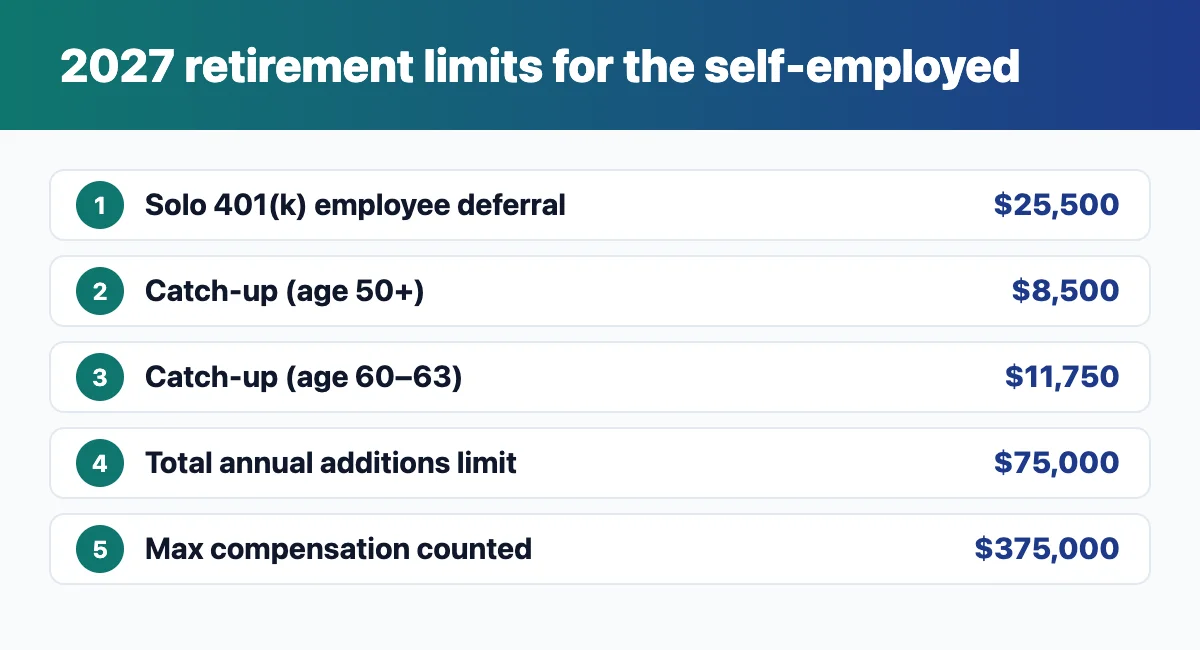
- Employee deferral: up to $25,500 in 2027 (plus $8,500 catch-up if you’re 50+, or $11,750 if you’re 60–63), and it can be Roth or pre-tax if the plan allows.
- Employer profit-sharing: up to 25% of compensation — for sole proprietors, effectively about 20% of net self-employment earnings after the deduction for half of SE tax.
Combined, the employee and employer contributions can’t exceed $75,000 for 2027, not counting catch-up contributions.
What is a SEP IRA?
A Simplified Employee Pension (SEP) IRA allows employer contributions only — the same roughly 20%-of-net-earnings calculation for sole proprietors — up to $75,000 for 2027. There’s no separate employee deferral, so you need a higher income to hit the maximum.
Solo 401(k) vs SEP IRA: side-by-side
| Feature | Solo 401(k) | SEP IRA |
|---|---|---|
| Who can use it | Owner (and spouse) only, no other employees | Any business, including those with employees |
| Employee deferral | Yes, $25,500 (2027) | No |
| Employer contribution | ~20% of net SE earnings | ~20% of net SE earnings |
| Total limit (2027) | $75,000 + catch-up | $75,000 |
| Catch-up contributions | Yes | No |
| Roth option | Often available | Allowed under SECURE 2.0 if the provider offers it |
| Loans | Plan may allow | No |
| Paperwork | Form 5500-EZ once assets exceed $250,000 | Minimal |
Example: $100,000 of freelance profit
Suppose you’re a sole proprietor under 50 with $100,000 in net profit. After subtracting half of self-employment tax (about $7,065), your compensation for plan purposes is roughly $92,935.
- SEP IRA: 20% × ~$92,935 ≈ $18,587
- Solo 401(k): $25,500 deferral + ~$18,587 employer contribution ≈ $44,087
At this income, the Solo 401(k) lets you shelter more than twice as much. At very high incomes, both plans can reach the $75,000 maximum.
Which plan should you choose?
Choose a Solo 401(k) if…
- You have no employees (other than a spouse).
- You want to maximize contributions on a moderate income.
- You want Roth contributions, catch-ups or a loan option.
Choose a SEP IRA if…
- You have employees or expect to hire soon (you must contribute the same percentage for eligible employees).
- You want the simplest setup and are fine with employer-only contributions.
- You decide late — SEP contributions can be made up to your tax-filing deadline, including extensions.
How to open one
Most major online brokerages offer both plans with no setup fees. You’ll need your EIN or SSN and business details. Track your profit carefully during the year — good bookkeeping (see our accounting software picks) makes the calculation easy, and contributions reduce the income tax side of your quarterly taxes.
Frequently asked questions
Can I have both a Solo 401(k) and a SEP IRA?
Technically possible in some cases, but the limits are shared and it adds complexity. Most freelancers pick one.
Can I contribute to a Solo 401(k) if I have a 401(k) at my day job?
Yes, but the $25,500 employee deferral limit is shared across all your 401(k)s. Employer contributions to your Solo 401(k) are separate.
What’s the deadline to contribute?
Employer contributions generally can be made by your tax-filing deadline (with extensions). Employee deferral rules for Solo 401(k)s are stricter, so check with your provider.
This article is for general educational purposes and is not tax, legal or financial advice. Confirm details with the IRS or a qualified professional before making decisions.