Losing employer coverage is one of the biggest worries people have before going freelance. The good news: the self-employed have more health insurance options than most people realize — and several valuable tax breaks that employees don’t get.
This guide explains every realistic option, how subsidies work, how to cut your premium with tax deductions, and the 2027 enrollment deadlines you can’t afford to miss.
Key takeaways
- For most freelancers in the US, an ACA Marketplace plan is the main option — and you may qualify for a premium tax credit based on your income.
- Self-employed people can usually deduct health premiums on their tax return.
- Open enrollment for 2027 coverage in HealthCare.gov states runs Nov 1, 2026 to Jan 15, 2027 — enroll by Dec 15 for coverage starting Jan 1.
Your main health insurance options
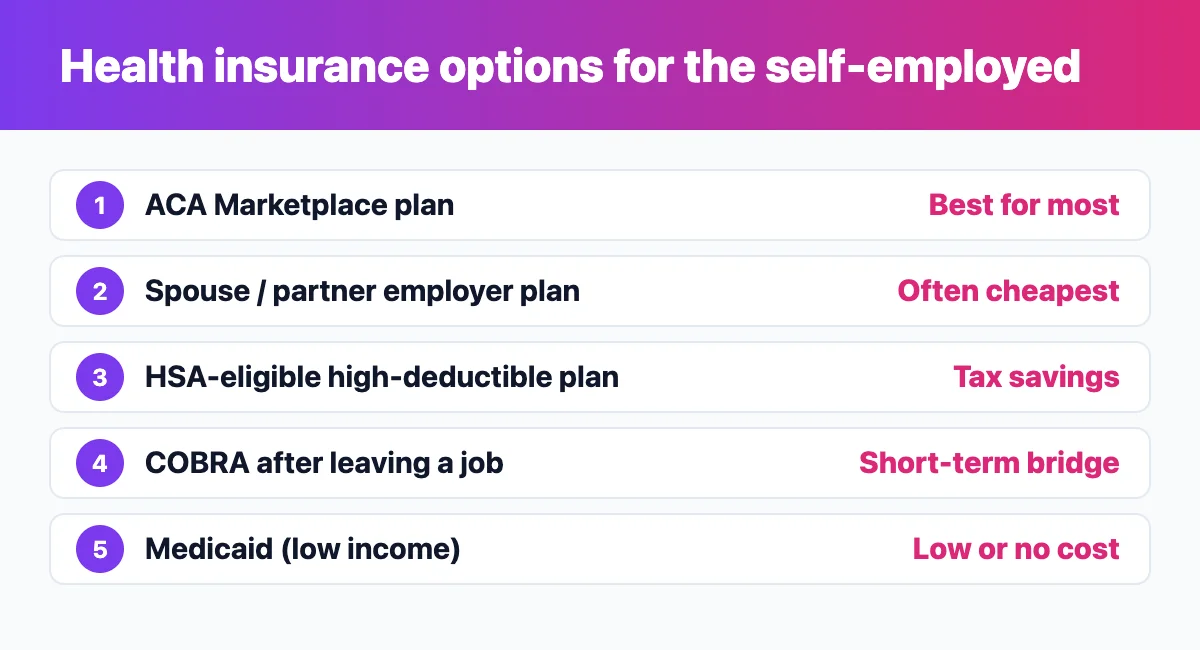
1. ACA Marketplace (HealthCare.gov or your state exchange)
Marketplace plans must cover essential health benefits and can’t deny you for pre-existing conditions. Plans come in Bronze, Silver, Gold and Platinum tiers: lower tiers have cheaper premiums but higher out-of-pocket costs. Depending on your estimated household income, you may qualify for a premium tax credit that lowers your monthly payment, and Silver plans may come with extra cost-sharing reductions if your income is lower.
Freelancer tip: your subsidy is based on your estimated income for the year. If you earn more than you projected, you may have to repay part of the credit at tax time — so update your application if your income changes significantly.
2. Join a spouse’s or partner’s employer plan
If your spouse has employer coverage, adding yourself is often the most affordable route because the employer pays part of the premium. Compare the total cost against a Marketplace plan before deciding.
3. COBRA
COBRA lets you keep your former employer’s plan temporarily, but you pay the full premium plus an admin fee. It’s useful as a short bridge — for example, if you’re mid-treatment — but it is usually expensive.
4. HSA-eligible high-deductible health plans (HDHPs)
If you’re healthy and want to lower premiums, an HSA-eligible plan lets you contribute pre-tax money to a Health Savings Account. HSA money grows tax-free and can be withdrawn tax-free for qualified medical expenses — a triple tax advantage. Check the IRS’s current-year contribution limits before you contribute.
5. Medicaid
If your income is low — common in the first year of freelancing — you may qualify for Medicaid, depending on your state’s rules. You can apply any time of year.
6. Short-term and health-sharing plans (use caution)
Short-term medical plans and health-sharing ministries can look cheap but often exclude pre-existing conditions, cap benefits, or aren’t insurance at all. Read the fine print carefully before relying on them as your only coverage.
2027 open enrollment dates
| Date | What happens (HealthCare.gov states) |
|---|---|
| Nov 1, 2026 | Open enrollment begins |
| Dec 15, 2026 | Deadline for coverage starting Jan 1, 2027 |
| Jan 15, 2027 | Open enrollment ends (coverage starts Feb 1) |
States that run their own exchange may use different deadlines, so check your state’s marketplace. Outside open enrollment, you generally need a qualifying life event — like losing other coverage, moving, marriage or having a baby — to get a special enrollment period.
Tax breaks that lower your real cost
- Self-employed health insurance deduction: if you have net self-employment profit and aren’t eligible for an employer-subsidized plan, you can generally deduct premiums for medical, dental and qualified long-term care insurance for yourself, your spouse and dependents.
- HSA contributions are deductible even if you don’t itemize.
- Premium tax credits reduce the premium itself, either monthly in advance or when you file.
These interact with your self-employment taxes — see our self-employment tax guide for how deductions affect quarterly payments.
How to choose the right plan
- Estimate your income realistically for the year.
- List your doctors and prescriptions and check each plan’s network and drug list.
- Compare the total annual cost (premiums + deductible + likely out-of-pocket), not just the premium.
- Consider an HSA plan if you rarely need care and can fund the account.
- Set a calendar reminder for open enrollment every year.
Frequently asked questions
What is the cheapest health insurance for self-employed people?
It depends on your income and location. With a premium tax credit, a Marketplace plan is often the lowest-cost option; for lower incomes, Medicaid may be available.
Can I deduct health insurance as a freelancer?
Usually yes, through the self-employed health insurance deduction, as long as you have net self-employment income and aren’t eligible for an employer-subsidized plan for that month.
Can I buy health insurance any time of the year?
Only during open enrollment, unless you have a qualifying life event. Medicaid and CHIP accept applications year-round.
This article is for general educational purposes and is not tax, legal or financial advice. Rules change and depend on your situation — confirm details with the IRS or a qualified professional.