
Affiliate marketing is one of the most popular ways to make money online: you recommend a product, someone buys through your unique link, and you earn a commission. No inventory, no customer support, no product creation. But “passive income” takes real work up front — mostly creating content people trust.
Key takeaways
- You earn a commission when someone buys through your tracked link.
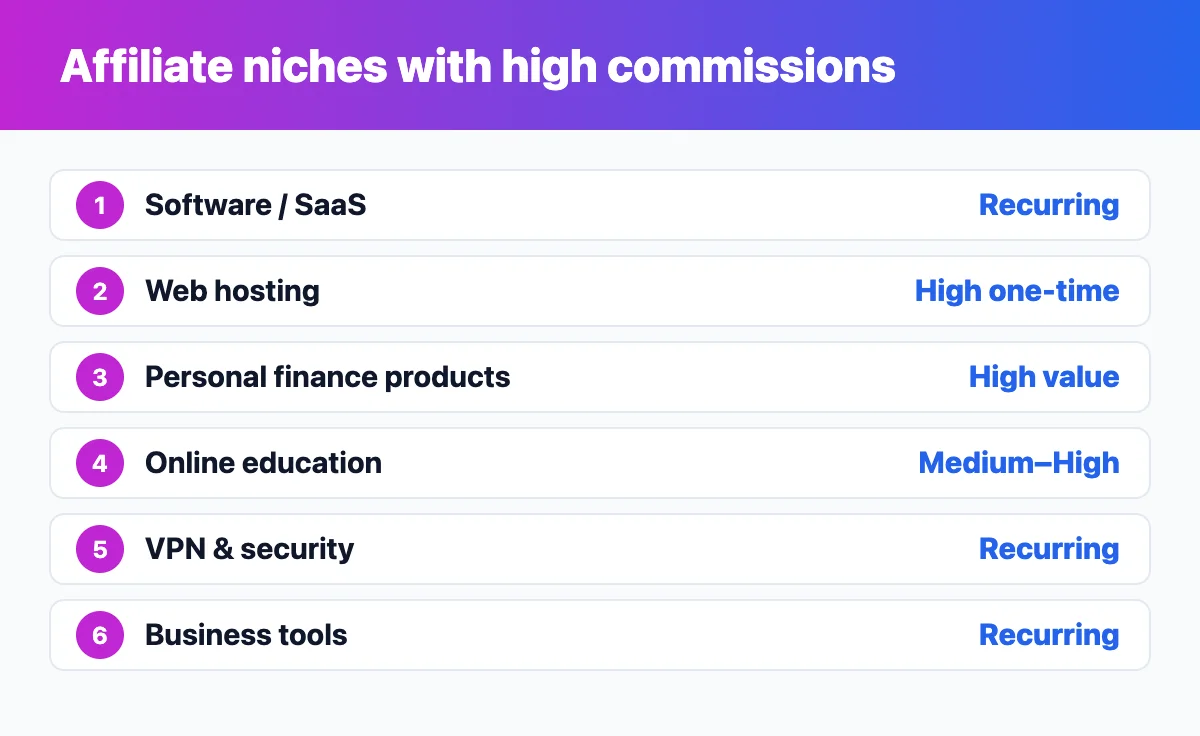
- Software, hosting, finance and education programs tend to pay the most, often with recurring commissions.
- US law requires clear disclosure of affiliate relationships.
How affiliate marketing works
- You join an affiliate program and get a unique tracking link.
- You share the link in a blog post, video, email or social post.
- A visitor clicks; a cookie records the referral.
- If they buy within the cookie window, you earn a commission.
Commission models
| Model | How you earn | Common in |
|---|---|---|
| Percentage of sale | % of order value | Retail, courses |
| Flat fee (CPA) | Fixed amount per sale/signup | Hosting, finance |
| Recurring | % every month the customer pays | SaaS, VPNs |
| Lead (CPL) | Per qualified lead | Insurance, education |
Step 1: Choose a profitable niche
Pick a niche where people buy things repeatedly or spend a lot: business software, freelancing tools, personal finance, careers and education. These niches also tend to earn higher display ad RPMs, so you can monetize the same traffic twice.
Step 2: Pick a platform
- Blog: best for search traffic and long-lasting content. See how to start a blog.
- YouTube: great for reviews and tutorials.
- Email newsletter: the highest-converting channel once you have an audience.
- Social media: fast reach but less durable traffic.
Step 3: Join affiliate programs
Start with products you already use. Many companies run in-house programs (look for an “Affiliates” or “Partners” link in the website footer). Affiliate networks group thousands of merchants in one dashboard. Amazon Associates is easy to join but pays relatively low percentages in many categories.
Step 4: Create content that converts
- “Best X for Y” lists — like our best accounting software for freelancers.
- Product reviews with honest pros and cons.
- Comparisons (“X vs Y”).
- Tutorials showing how to use a tool to solve a problem.
The most successful affiliates show real experience: screenshots, test results and specific use cases. Readers — and search engines — reward honesty.
Step 5: Drive traffic
SEO is the most scalable long-term source. Target specific, buyer-intent keywords, interlink your articles and update them regularly. Build an email list from day one so you own your audience.
Affiliate disclosure rules
In the US, the FTC requires you to clearly disclose when you may earn money from links. Put a short, plain-language disclosure near the top of the content — not hidden in the footer. Many programs also have their own disclosure requirements.
Beginner mistakes to avoid
- Promoting products you’ve never used
- Choosing low-commission products only
- Stuffing every paragraph with links
- Ignoring email list building
- Giving up before content has time to rank
How much can beginners make?
Most beginners earn little in the first few months. With consistent content in a good niche, many affiliates build to a meaningful monthly side income within a year — and a few turn it into a full-time business. Remember to report the income and plan for self-employment tax.
Frequently asked questions
Can you do affiliate marketing with no money?
Yes — you can start with free platforms like YouTube or social media. A blog needs only a domain and hosting.
Do I need a website for affiliate marketing?
No, but a website gives you more control, better SEO and a long-term asset.
How long does it take to earn the first commission?
Anywhere from a few weeks to several months, depending on your traffic and niche.