When you work for an employer, taxes are withheld from every paycheck and your employer pays half of your Social Security and Medicare taxes. When you’re self-employed, you pay both halves — and nobody withholds anything for you. That’s why tax season surprises so many new freelancers.
Here’s a plain-English guide to how self-employment tax works, how much to set aside, and how to pay quarterly so you avoid penalties.
Key takeaways
- Self-employment tax is 15.3%: 12.4% Social Security + 2.9% Medicare.
- For 2027, the Social Security part applies to the first $192,300 of combined earnings (up from $184,500 in 2026).
- If you expect to owe $1,000 or more, you generally need to pay estimated taxes four times a year.
What is self-employment tax?
Self-employment (SE) tax is how independent workers pay into Social Security and Medicare. It’s separate from — and in addition to — your regular income tax. You owe it if your net earnings from self-employment are $400 or more for the year.
The 2027 self-employment tax rate
| Part | Rate | Applies to |
|---|---|---|
| Social Security | 12.4% | Up to $192,300 of earnings (2027) |
| Medicare | 2.9% | All net earnings |
| Additional Medicare | 0.9% | Earnings above $200,000 (single) / $250,000 (married filing jointly) |
The wage base is combined with any W-2 wages: if you also have a job, your W-2 Social Security wages count toward the cap first.
How to calculate self-employment tax
- Start with your net profit (business income minus business expenses) from Schedule C.
- Multiply by 92.35% to get net earnings subject to SE tax.
- Multiply that by 15.3% (adjusting the Social Security part if you’re above the wage base).
Example: net profit of $60,000 × 92.35% = $55,410. $55,410 × 15.3% ≈ $8,478 in self-employment tax — before regular income tax.
The good news: you can deduct half of your SE tax when calculating your adjusted gross income, which lowers your income tax.
How much should freelancers set aside?
A common rule of thumb is to save 25–30% of every payment you receive in a separate tax savings account. Higher earners or people in high-tax states may need more. Track it monthly so the quarterly payment is never a shock.
Quarterly estimated tax deadlines
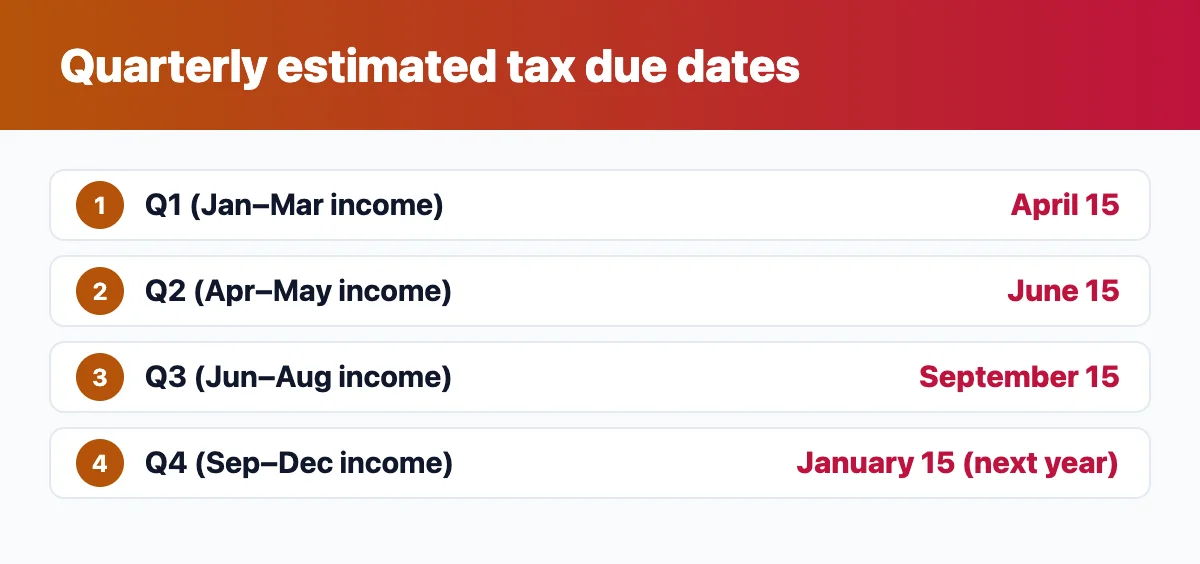
Estimated taxes cover both income tax and SE tax. The usual due dates are April 15, June 15, September 15 and January 15 of the following year (shifted to the next business day if they fall on a weekend or holiday). You can pay through IRS Direct Pay or your IRS online account.
How to avoid underpayment penalties (safe harbor)
You generally avoid a penalty if your payments plus withholding cover at least 90% of this year’s tax, or 100% of last year’s tax (110% if your prior-year AGI was over $150,000). Many freelancers use the prior-year rule because it’s predictable.
Deductions that reduce your tax bill
- Home office deduction for a space used regularly and exclusively for business.
- Software, equipment and internet used for your business — see our best accounting software for freelancers to track them.
- Self-employed health insurance premiums (full guide here).
- Retirement contributions to a Solo 401(k) or SEP IRA — compared in our Solo 401(k) vs SEP IRA guide.
- Qualified business income (QBI) deduction of up to 20% for many pass-through businesses (lowers income tax, not SE tax).
Should you form an LLC or S corp?
A single-member LLC doesn’t change your SE tax by default. Electing S corporation status can reduce SE tax once your profit is high enough, because you pay yourself a reasonable salary and take the rest as distributions — but it adds payroll costs and paperwork. Talk to a CPA before switching.
Frequently asked questions
Do I pay self-employment tax if I also have a job?
Yes, on your side income, if net earnings are $400 or more. Your W-2 wages count toward the Social Security wage base first.
What happens if I miss a quarterly payment?
The IRS may charge an underpayment penalty calculated like interest. Pay as soon as you can to reduce it.
Is self-employment tax the same as income tax?
No. SE tax funds Social Security and Medicare; income tax is separate and based on your tax bracket.
This article is for general educational purposes and is not tax, legal or financial advice. Rules change and depend on your situation — confirm details with the IRS or a qualified professional.